Social invisibility and being forgotten
Maigret and the Dead GirlSocial invisibility and being forgotten is the defining paradox of Louise Laboine’s posthumous existence: she had been known by name and had belonged to a family and a circle of childhood companions, yet after her death no one seemed to remember her or feel concern for her. The investigation makes that contradiction visible. It reconstructs her not through a single intimate witness, but from scattered traces that turn an anonymous body into a person whose life had been lived among others.
The Paradox of Having Been Known
The account insists that Louise had not always been unknown. She had a father and a mother; at school she had friends among the other children. As she grew up, men and women knew her, spoke with her, and called her by her name. These details matter because they rule out simple obscurity: Louise had once occupied ordinary relationships and been recognized within them. The shock lies in the distance between that remembered past and the present in which her death appears to leave no impression on anyone.
The narrative gives this distance its starkest form by placing a history of human contact beside the claim that, now she is dead, no one seems to remember her and no one is concerned, as if she had never lived. The comparison does not establish that every person from her past has literally forgotten her; instead, it describes the near-total absence of anyone who comes forward or appears to feel responsible. In this account, being forgotten is less a fact about what each acquaintance knows than a condition revealed by the failure of memory to become care.
Recognition as a Gradual Process
The investigation initially encounters Louise as fragments rather than as a known individual. Two days earlier, the investigators had not known she existed. She becomes first a blue shape and a profile against the wet pavement of Place Vintimille, then a white body on a marble slab at the Medico-Legal Institute. Only after these bodily impressions does she acquire a name, and the picture of her begins to form, still indistinct. The sequence makes recognition a slow act of assembly: a body is seen, a name is recovered, and the person’s life becomes imaginable without ever becoming completely available.
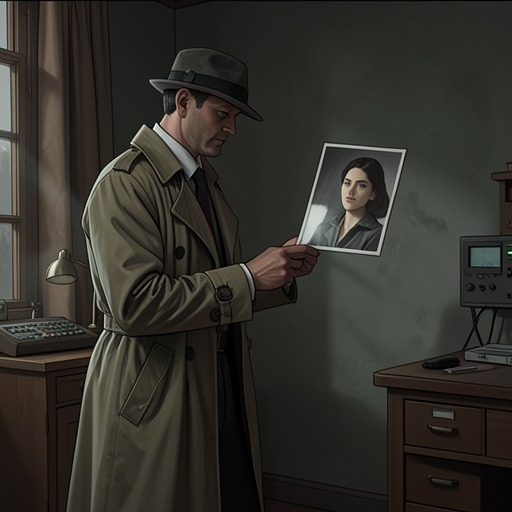
The photographs reinforce that process. In four proofs, Louise appears in different clothes: a black dress in two, a brown checked coat in another, and evening dress in the last. The images offer specific appearances, not a complete explanation of who she was. Her expression seems to ask an unanswerable question, while the photographs also suggest how readily someone like her might pass through the Paris streets, pause briefly at a shop window, and continue toward an unknown destination. The picture helps individualize her, but it cannot fill the silence around her or tell the investigators what she expected from the people she had once known.
Solitude in the Everyday City
What testimony does emerge places Louise within a narrow, repeated geography. Rose’s account indicates that Louise had no regular work for some time. She did not travel far: she walked down Rue de Clichy and sat in the garden in front of the Trinité church. This routine gives her a recognizable presence in the neighborhood, but not one that has developed into companionship or protection. The garden is a public place where she can be seen, yet the account emphasizes her solitary occupation of it rather than any connection she formed there.
That later pattern of isolation is set against the earlier story of a sixteen-year-old who ran away from her mother and had to hide under a bed every day for months. The remembered circumstance places her loneliness within a longer trajectory; it was not confined to the days immediately before her death. Madame Crêmieux described her as standoffish and unwilling to speak to anyone, while Rose had seen her sitting alone for hours on a bench in the Trinité garden. These observations do not make solitude proof of a fixed personality. They show how others encountered her, and how easily a life spent in public view could remain socially unread.
The Body, the Name, and the Limits of Recovery
The investigation’s movement toward recognition culminates in a sharp reversal: Louise is no longer merely an unnamed shape, but neither does the recovered name undo the abandonment that her case exposes. The body on the wet cobbles of Place Vintimille is the physical endpoint of the path described in the investigation. Her death makes visible the gap between having once been part of other people’s lives and being left, at the end, without an evident circle of remembrance or concern.
The narrative therefore treats identification as necessary but incomplete. A name and a photograph allow the investigators to begin assembling a picture; scattered testimony supplies places, habits, and earlier circumstances. Yet this reconstruction does not turn the fragments into a full account of Louise’s inner life, nor does it supply a witness who can make her past feel socially present. The idea of being forgotten resides in that tension: the investigation can bring Louise back into view for the reader, while the evidence of her former relationships and later solitude leaves unanswered how someone once known by name could become so nearly absent from other people’s attention.